

A guest asks to book three nights in October. The request sits in an inbox, nobody opens it until Tuesday. By then it has expired, the guest has booked elsewhere, and here is the part most operators never find out: those three nights are still blocked on the calendar because Airbnb held them the moment the request arrived, and only the host can release them.
One unanswered message, and the unit is off sale for dates nobody is staying.
That is the visible cost. The larger one is quieter. Response rate affects search placement, and the ranking algorithm weighs how responsive a host is alongside cancellations and reviews. Reply quickly and you compete on price and photography. Reply slowly and you compete from further down the page.
Most properties work to a rule of thumb: answer within 24 hours. The published standard is tighter, and the gap between the two is where bookings quietly go missing.
Here is what Airbnb measures, what it expects, and how to hold that pace across a portfolio without putting anyone on the inbox at midnight.

Response rate is the percentage of new inquiries and reservation requests you responded to within 24 hours over the past 30 days. Response time is the average time it took you to respond to all new messages in the same period. Two different metrics, carrying two very different weights.
Most articles treat them as interchangeable, which sends effort to the wrong place. Response rate is the one that counts: it affects Superhost status and search placement. Response time mainly tells guests what to expect and has far less bearing on your standing as a host.
A property with a fast average that occasionally lets one message slip is in worse shape than a slightly slower property with no gaps at all.
Any of these counts as a response:
A quick no protects your rate as effectively as a yes. The only thing that damages it is letting a request expire.
What doesn’t count: follow-up messages. You do not need the last word in a conversation. Both metrics are settled by your first reply, which is where the effort belongs.
The windows: response rate runs on a rolling 30 days. The Superhost version is based on your first reply to each new message thread over the past 12 months, assessed quarterly.
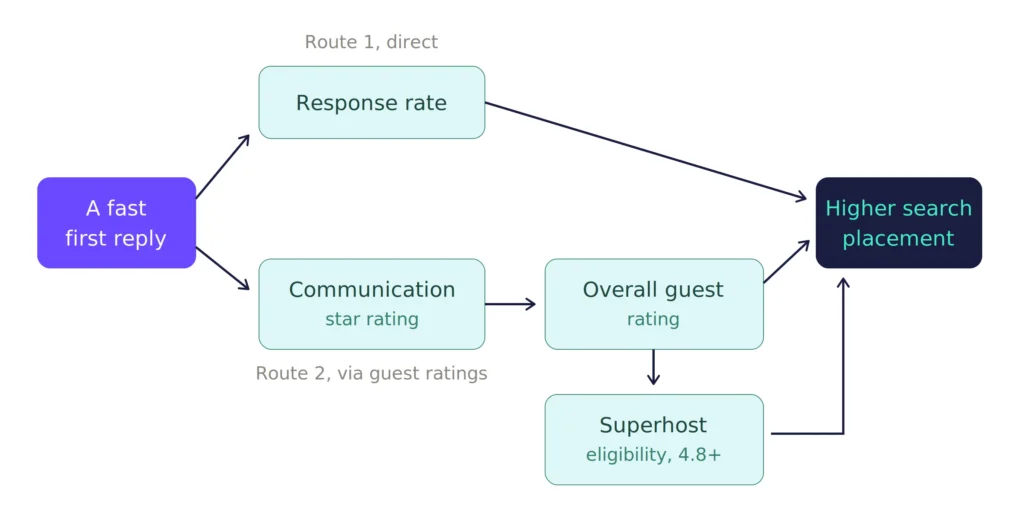
Yes, and through two separate routes that reinforce each other.
A quick response is one of the most reliable ways to convert an inquiry and to protect the rate itself, which in turn helps a listing appear higher in results.
The ranking mechanics go further than most operators assume. For homes, the algorithm weighs the Superhost criteria directly, meaning cancellations, host responsiveness, and ratings and reviews. Communications between hosts and guests are also among the characteristics used to judge listing quality.
After every stay, guests rate the property across seven categories. One of them is Communication, and the question guests answer is whether the host responded to messages promptly.
That rating rolls into your overall score, which drives Superhost eligibility at 4.8 or higher and the Quality factor in search. Better-rated listings tend to rank higher, so a run of slow replies costs you twice over the same period.
Communication is also one of the few rated categories that can improve within a week at no cost. Improving cleanliness scores takes staff time, accuracy takes a full listing audit, and location cannot be changed at all. Response speed only requires a decision about process.
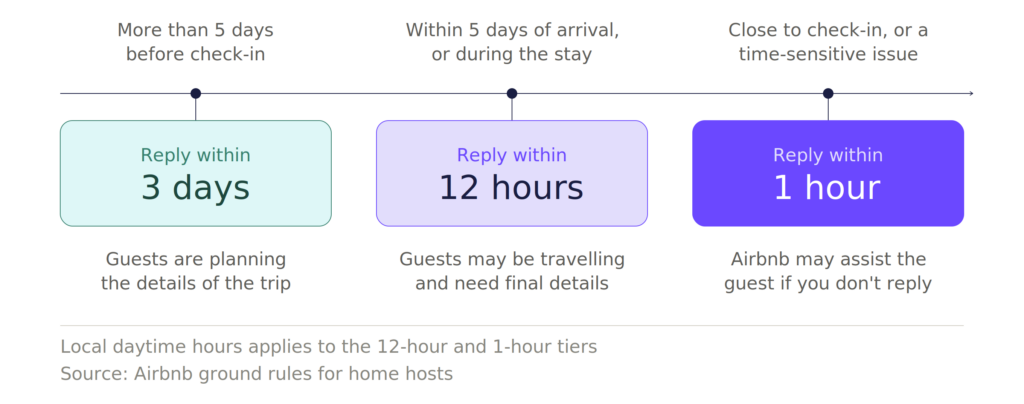
Three tiers, depending on how close the guest is to arriving. And this is not guidance: timely communication is one of four areas hosts are required to meet, alongside listing accuracy, honouring reservations and refunds, and cleanliness. It carries the same weight as having a clean room.
For a guest question material to their stay:
| When the guest writes | Expected response |
|---|---|
| Check-in is more than five days away | Within three days |
| Within five days of arrival, or during the stay | Within 12 hours, local daytime hours |
| Close to check-in, or a time-sensitive issue during the stay | Within 1 hour, local daytime hours |
The one-hour tier covers the moments where delay does most damage. A problem at check-in carries a different urgency from a question three weeks out. There is also a consequence attached: where a host stays unresponsive during a live trip issue, Airbnb may step in and assist the guest directly. Few operators would choose to have that conversation handled for them.
The 12-hour tier has the larger effect on staffing. From five days before arrival, every guest message carries a same-day expectation rather than an urgent-only one.
The requirement covers hosts and co-hosts alike, and applies both before and during stays.
Guests are told that the vast majority of hosts respond within 12 hours, and that more than half of all trip requests are accepted within one hour of the host reading them. That is the field you compete in, which makes an hour the working norm rather than a stretch target.
Three things hang on holding that pace.
Somewhere around fifteen units, this stops being a question of personal discipline and becomes one of process design. Aparthotel portfolios, apartment and holiday rental managers, boutique groups, guesthouses and hostels tend to reach that point earlier than they expect.
One property, a handful of inquiries a month. Notifications and habit will hold it. Low volume makes the 90% threshold unforgiving: at five inquiries, one missed message drops you below.
Ten to twenty units across two cities. Now you need a rota. Guests write in the evening, at weekends and from other time zones, so the one-hour tier falls outside office hours more often than inside them.
Forty listings and above. Operations design. Covering the one-hour tier across several markets means either dedicated messaging cover or automation handling routine volume while the team handles exceptions.
Because only the first reply is measured, the work has to happen within the first hour of a message arriving. Clearing a backlog next morning is still good hospitality, but the metric is already set.
Instant Book helps with part of this. Removing the reservation request lifts your response rate, and it is a sensible setting for most properties. Message volume stays where it is, though. Guests still ask about parking, early check-in and door codes, those messages still count, and stays over 31 nights arrive as requests either way.
Your property information. Whatever tool you use, an automated answer can only be as accurate as what sits behind it.
Before switching anything on, check that these agree with your Airbnb listing:
The same ground rules that require timely communication also require the listing page and any additional host statements to describe the property accurately. An answer given to a guest is a statement about your listing, so a stale check-in time is more than an inconvenience.
It is an afternoon of work at most, and it is the difference between fast answers being useful and fast answers being a liability.
Airbnb gives hosts a capable set of messaging tools, and for many properties they cover the job well. Operators running several channels or a portfolio of units usually add a guest communications platform on top, connected through Airbnb’s Messaging API.
Quick replies are templates you write in advance, personalised with around forty fields pulled from your listing and the reservation: guest name, check-in time, Wi-Fi password, entry code, directions. Airbnb suggests relevant templates using AI, auto-translates into the guest’s language, and schedules them against triggers such as a new reservation or check-in.
They are genuinely good, and worth setting up properly whatever else you run. Between quick replies, scheduled messages and Instant Book, a single property with a predictable pattern of questions can cover the standard comfortably. Many do exactly that.
Two situations tend to prompt operators to add something alongside them. Multichannel selling, where the same property also takes bookings through WhatsApp, Booking.com, email and its own website, and each channel needs the same answers kept current. And scale, where a portfolio generates enough volume, and enough unusual questions, that preparing a template for everything stops being realistic.
A PMS or channel manager brings Airbnb messages into view as well, which is useful for oversight. Those systems are built around rates, availability and reservations, so guest conversation is a different job from the one they were designed for.
HiJiffy is a guest communications platform for hotels, aparthotels and apartments. Every guest message, from every channel, answered from one knowledge base. The Airbnb integration brings Airbnb into that set through the platform’s official Messaging API, the same route already used for other OTAs.
What the property gains is coverage: the same knowledge, the same standard of answer, at any hour, on every channel a guest might use.

What changes in practice: a question arriving at 10pm is answered within seconds from your knowledge base, in the guest’s language, without anyone being on shift. Anything the AI cannot resolve waits in one inbox with the reservation details attached, ready for the team in the morning. The first reply, the only one the metric counts, has already gone.
Against the three tiers:
Either mode, or both. Fully automated, team-assisted, or a mix. You can switch automation on or off for Airbnb without affecting your other channels.
On setup, your listing content imports from Airbnb into the property knowledge base in one step and is rewritten by AI into usable answers. You review it before anything saves, which is where the checks above get done. Closing a conversation in HiJiffy also closes it on Airbnb, so both inboxes stay in step.
For hotels, aparthotels, serviced apartments, holiday rental portfolios, guesthouses and hostels already on HiJiffy, the Airbnb channel is included in Pro and Premium plans and activated at no extra cost.
Which brings this back to the request that expired on a Tuesday. Nothing about it was a hospitality failure. The team would have answered well had they seen it. They were not looking at the right inbox at the right hour, and the platform does not distinguish between a host who chose not to reply and one who never saw the message.
Closing that gap is an operational decision, not a staffing one. Nobody has to sit up for it.
Yes. Airbnb states that response rate impacts both Superhost status and search placement. It also affects ranking indirectly because guests rate hosts on Communication after every stay, and that rating feeds the overall score Airbnb uses to assess listing quality.
90% is the minimum threshold for Superhost eligibility, measured as replying to new messages and accepting or declining reservation requests within 24 hours. Properties competing seriously aim higher, since at low inquiry volumes a single missed message can drop you below the threshold.
It is the percentage of new inquiries and reservation requests you responded to within 24 hours over the past 30 days. Accepting, pre-approving, declining, sending a message or sending a special offer all count as responses. The Superhost version is calculated separately, based on your first reply to each new message thread over the past 12 months.
No. Airbnb states that response rate and response time are not affected by follow-up messages, and hosts do not need to send the final message in a conversation. Only the first reply to each new inquiry or reservation request is measured.
Airbnb’s ground rules set three expectations for questions material to a guest’s stay: within three days when check-in is more than five days away, within 12 hours within five days of arrival or during the stay, and within one hour for time-sensitive issues close to or during the stay, during local daytime hours.
The request expires after 24 hours and no reservation is created. The guest is free to book elsewhere. The requested dates remain blocked on your calendar until you unblock them manually, so an unanswered request can cost both the booking and the subsequent availability.
Declining within 24 hours counts as a response and does not affect Superhost status or search ranking. Airbnb notes that frequent declines can negatively affect reservation rates and where a listing appears in search, so the issue is a pattern of declining rather than any single decline.
Yes, because there is no reservation request to respond to. It does not reduce guest messages, which still count toward your response rate. Stays longer than 31 nights arrive as reservation requests, regardless of Instant Book.
Yes. Airbnb offers quick replies and scheduled messages natively, which cover predictable questions well. Platforms connected to Airbnb’s Messaging API, such as HiJiffy, add answers drawn from a property knowledge base across every channel, and route anything unresolved to a person on the team. On HiJiffy the Airbnb channel is included in Pro and Premium plans and activated at no extra cost.