



Introduction
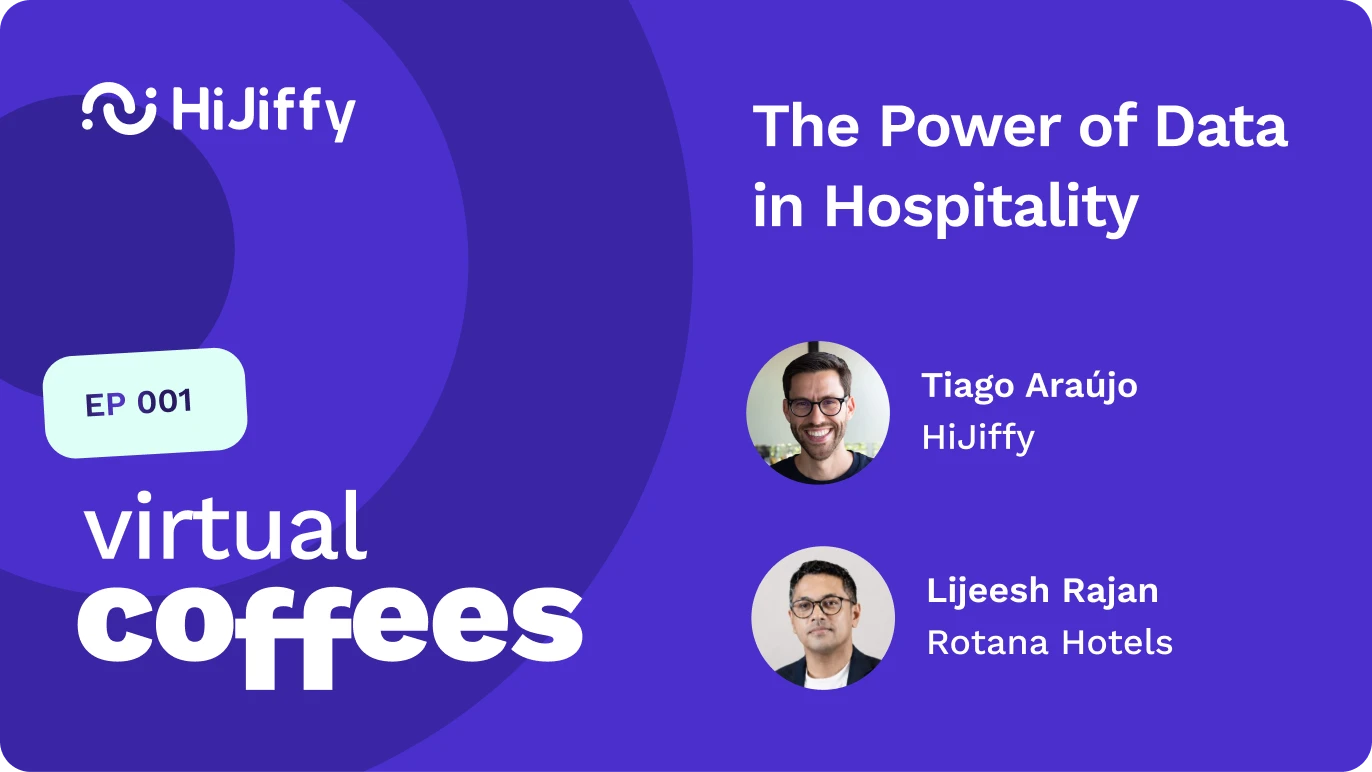
In the first episode of Virtual Coffees, HiJiffy’s CEO, Tiago Araújo, sits down with Lijeesh Rajan, Head of Technology Strategy and Services at Rotana Hotels, to discuss the power of data in hospitality. They get into why the industry’s fragmented systems make good data so hard to come by, how a customer data platform can turn scattered profiles into a single “golden record”, and why that foundation has to be in place before any AI or personalisation can deliver. It’s a practical look at building a data-first operation, from quality and governance to loyalty and guest experience.
Transcript
Tiago Araújo (00:01): Hi everyone. We’re here for the first episode of our Virtual Coffees. These Virtual Coffees will be hosted by me, Tiago. I’m the CEO of HiJiffy. The goal here is to create a space for virtual coffees, or chats, within the hospitality industry, with professionals who I believe can bring a lot of ideas and a lot of different approaches to specific topics that I find relevant. So most of my guests will be people who are within hotel operations, leaders, innovators, or experts in specific fields. We’ll do it as casually as possible, with real conversations. Nothing too formal, nothing too long. Our main goal is to make something relevant and quite short.
For my first invitation, I talked with Lijeesh from the Rotana Group. He’s Head of Technology Strategy and Services at Rotana Hotels. He has long experience within the hospitality industry in digital transformation. I don’t know if I’m okay to say it, but around 20 years already. So a very, very long time.
Lijeesh Rajan (01:20): Almost two decades, yeah.
Tiago Araújo (01:22): Two decades already, and he’s been at Rotana on this IT strategy for a very, very long time. Lijeesh, to start with, would you like to introduce yourself, and Rotana too, with whatever you find relevant?
Lijeesh Rajan (01:37): You did a very good intro. I don’t think I need to rephrase anything more. Thank you. I’m happy to be here and looking forward to a good chat.
Tiago Araújo (01:54): Great, amazing. So the topic today will be around the power of data in the hospitality industry, where our focus areas will be mainly smarter decision-making, personalised guest experience, and building long-term guest loyalty. For my first question: from guest preference to operations, where do you see the biggest opportunities for hotels like Rotana to leverage data more effectively?
Lijeesh Rajan (02:34): I think, as a company, within our strategy meetings and our digital teams, everybody pretty much in the hospitality industry understands that data is very crucial. There are the old cliché lines of data being oil and all that. But when it comes to actually getting things done, or getting to know your data, or identifying your data, it’s a given that our industry is quite fragmented by technology and digital touchpoints, whichever way we try to articulate it.
The way the data enters, the way the central distribution systems bring it, the booking engines, your property operating systems, your check-ins, your registrations, payment, anything and everything you see in a normal customer journey: from exploring, booking, checking in, paying, checking out, rediscovering, and all of those stages, multiple products are involved, multiple digital touchpoints are involved. So one particular area we focused on was ensuring the data we bring in is of an excellent quality that we can work with. Otherwise it’s garbage in, garbage out.
So we focused, as a business, on having a very CDP and CDM based approach, a customer data management platform, to ensure that the data we have can be used, is given by the guest, and lets us create a bit of an RFM approach, based on recency, frequency, and monetary value. As a Middle East group, we do have loyalty programs running for our diners, our members, and even for bookers. So it was quite crucial for us to sustain quality datasets to run these programs and to engage, connect, and award points for them.
This put us in a very, very clinical role of ensuring data quality, keeping that data intact, and making sense out of the data based on what the customer wants: how to visualise it, how to capture their preferences, and serve them better. That’s the high level. So the focus was to get the best quality data in, and only keep in store what’s relevant. Otherwise, everything else is just noise.
Tiago Araújo (05:01): Of course. That’s one of the biggest problems: where do you take out the noise, and where do you keep whatever is solid and important? I was curious, because you were saying you’re a Middle East company, but from what I understand and know from Rotana, you’re spread across the world nearly, right? You’re quite international, and even the Middle East is a region with a lot of countries and different realities. Is data helping you in any way to adapt to these different realities?
Lijeesh Rajan (05:40): 100%, actually. One of the major challenges, maybe 10 or 15 years back when we started stepping out of our normal territory as a UAE, homegrown company, was that when we started moving out to other countries, data was always siloed. The regulations were always a challenge. I don’t want to say GDPR is a problem. No, no, this is only to protect and improve the way we use the data.
So, going back to the point about how to use quality data, use it to the advantage of operating, visualising, or serving the customer, these regulations basically help us so that we go with that quality enforcement process, storing and processing. In every country, and we’re in Turkey, we’re in Saudi, we even have franchisee hotels in Russia, in any environment we work in as a company, this really helps us to be guided by the principle of going by the data protection laws, being vigilant, and being very transparent about how we use and capture data. And that has been a way of managing the business from day one: from the leadership, and from within the business teams. So even when you partner with businesses, this has always been our sense of, I would say, urgency, to say this is the principle we want to work by.
We always uphold that theory that data is important, whichever means you use. Not just limited to guest data, because that’s always the normal way of saying it, and that’s where the noise comes in. But not just that, whether it’s transactions, commercial, revenue, or PCI, this has always been the strength. And it’s also endorsed to push our other cybersecurity initiatives and data protection initiatives. You can only protect what you know, what you understand. So this has always been the base principle, the first step we take.
Tiago Araújo (07:55): Talking with a lot of vendors and partners, I think more and more that hotels should always look into what data this vendor is going to bring me, and then work with it within my whole pool. I had one last question for you that I’m really interested to pick your brain on. Obviously, with 20 years in the industry, you’ve already led a lot of digital transformation initiatives. My question is: can you share an example where data really helped you drive smarter decisions, or even helped you create a more personalised guest experience?
Lijeesh Rajan (08:37): I think one of the main strategy initiatives, which I quoted in one of the first questions, is the approach of implementing a customer data management platform to centralise our membership program and operate it. This was a challenge given to us, even with our ongoing partnership recently announced with Global Hotel Alliance. We are merging with them for one of our programs, Rotana Discovery.
One of the main challenges was connecting our 70-plus hotel portfolio into a single view, where all of these multiple profiles, because a customer can have 72 profiles spread around, get elevated to a central repository, a so-called golden record, avoiding all that noise. This ensures the data can then be measured for a member, to really understand an articulated segment. This was one of our key differentiators, when we understand the customer better. And that RFM was only made possible by the behaviours we started understanding: the spend behaviours, the F&B behaviours. It all became quite seamless only because of the CDM approach we’d taken.
With that, when we started looking at commercial performance analysis, or even, to an extent, point of sales and commercial performance monitoring, it all became very, very easy. It became so easy to understand, let’s say, that Tiago is a customer and how you spend across the company. And that improved conversion a lot for us, because we don’t bombard the customer with lots and lots of offers. We’re able to understand which type of customer you are, your engagements, and your preferences.
One of Rotana’s core principles of engaging customers, our motto, was “treasured time is our promise to you.” So with those know-your-guest programs internally, when we measure repeat customer recognition and understand the best next course of action we should take, all of this became possible. These are little touchpoints you feel, but it would never have been possible without really having that data at hand.
Now, it’s quite important to understand: today, if a business does not have that kind of maturity with data, and you’re not able to employ the new agentic models or analysis LLMs, you will never be able to endorse AI-driven experiences for your operations team. Whatever we’ve done today to improve, to narrate, visualise, or augment any experience for our operations, it’s because of that data quality. And it converted into upselling, and, in the virtual section, I could say it was always a double-digit growth. That’s the best part of it.
I don’t know if I can handpick one or two areas; this is what we explain. But I think there’s no stopping it. It’s continuous improvement. And what I’m excited about is that, with the right dataset, with the technology, including any agentic or AI-based initiative you plug in, without compromising any experience with the customer, is the right strategy for any hotel group. And if you haven’t started, it’s still not too late. You should, because anybody who wishes to invest and enable an AI-driven experience or personalisation, if you still don’t have data, what will you do? It will be very, very intrusive, and it won’t make anything worth looking at.
I think we, as a group, have excelled, but this is not an end game. We continuously grow, evolve, based on market conditions and the touchpoints we deliver true to the business.
Tiago Araújo (12:40): Sure, sure. For me, as a key takeaway from this conversation, I always see it as different layers when people talk about data. In my perspective, a lot of people talk about what they can do with the data. But before that, there are always foundations within the hospitality industry. There’s one foundation, which is making sure you’re getting all your data, because you work with tens of tech vendors right now.
Lijeesh Rajan (13:07): Tens of providers, right? Yeah, yeah.
Tiago Araújo (13:09): The second layer, for me, is making sure the data is then organised in some source of truth, like you were saying. Because just having data…
Lijeesh Rajan (13:17): Classify, value, who owns it, who processes it, and what you need to store. Exactly.
Tiago Araújo (13:24): And then, talking about data analysts or agentic AI, you can add that on top. Because if you don’t have these pillars or these sources, if you start from the top, everything will go wrong, in my perspective.
Lijeesh Rajan (13:40): I completely agree. I can’t even say it any better; that’s exactly a better narration of it. And businesses will find low-hanging fruit for immediate discovery, immediate value creation. If you try to do everything with one product, one vendor, or one portfolio, you can’t achieve this, because of that fragmented technology landscape of hospitality in general.
Tiago Araújo (14:03): I found it very insightful for other people who are looking into how to use this data internally in the hospitality industry. Thank you so much, Lijeesh, for joining my first Virtual Coffee.
Lijeesh Rajan (14:19): Thank you, Tiago, I enjoyed the conversation.