

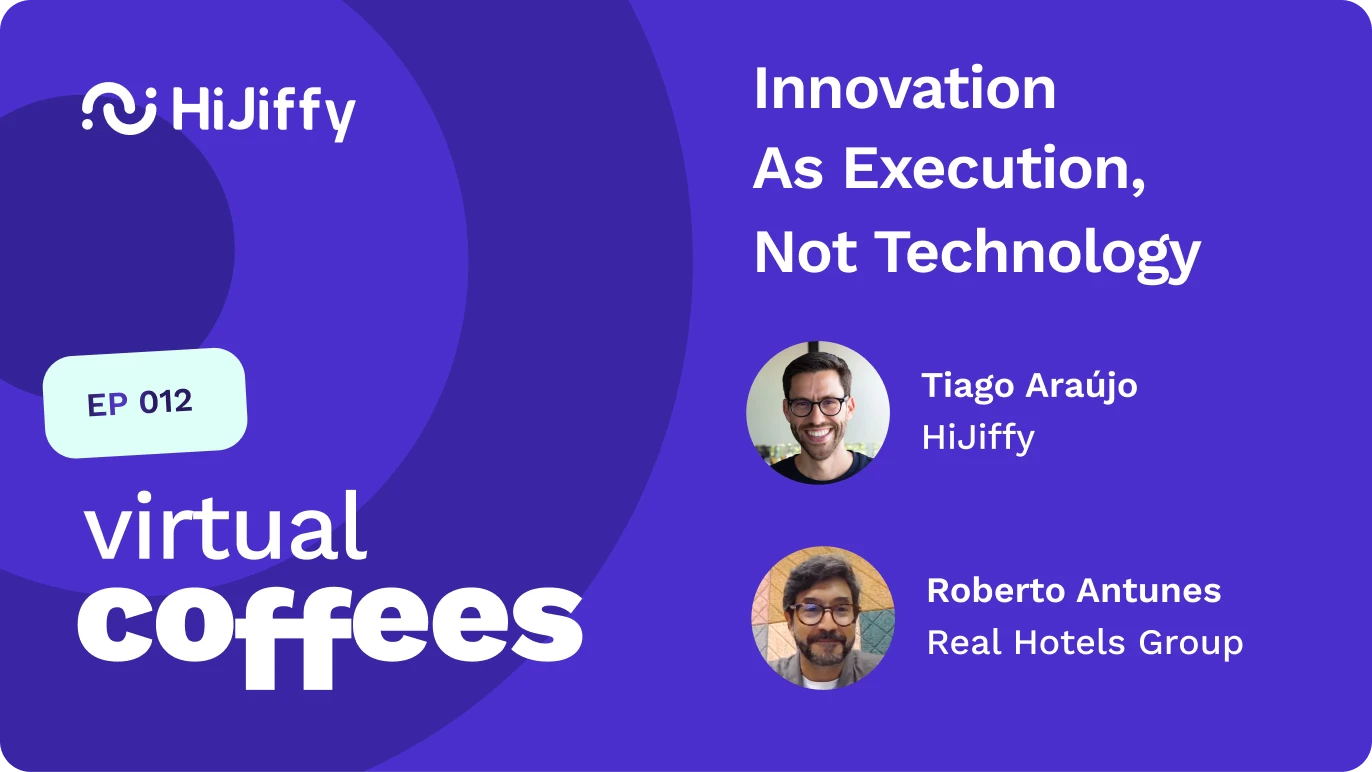

In this episode, HiJiffy’s CEO Tiago Araújo talks with Roberto Antunes, Marketing, Digital and Innovation Director at Real Hotels Group, who recently moved from leading a tourism innovation centre to owning innovation inside a hotel group. Roberto reflects on what changed when he crossed from the innovation side to the adopter side, why he now sees execution, people, and process as more than the technology itself, and why hotels should get their first-party data connected and clean before reaching for AI.
Tiago Araújo (00:00): Hi everyone, we’re here today in one more episode of Virtual Coffees, with people who work within the hospitality industry. We’re here with Roberto Antunes today. Thank you so much, Roberto, for joining us.
Roberto Antunes (00:17): My pleasure.
Tiago Araújo (00:19): Before we kick things off, would you like to give a quick introduction about yourself?
Roberto Antunes (00:26): Sure. Roberto here, currently at Real Hotels Group. A brief story about myself: I’ve always been passionate about tourism. I studied economics and then afterwards started working as a manager. My career and background is mostly in FMCG at international companies. I did the full process, let’s say, from a trainee up to international marketing director, in several parts of the world, namely in Europe and also in South America.
But a few years ago I decided to pursue this dream to engage in tourism, and moved into the kick-off of an innovation centre for tourism in Portugal, as an executive director. It has been a real pleasure, for the period of approximately six years that I led this organisation, and I went through the whole process of innovation, connecting with startups, with public institutions, with private companies. That was a move that put a lot of value into the next move, which was getting back into the real deal of business, this time with capabilities in innovation and really able to connect with the startup world. This is where I’m at now, at Real Hotels Group, as Marketing, Digital and Innovation Director, with a lot of weight on my shoulders in order to innovate in the current world.
Tiago Araújo (02:39): One thing that excites me the most while talking with you is about this move. You just moved from wearing NEST, which you already mentioned, but for whoever doesn’t know, it’s a tourism innovation centre, to now owning marketing, digital, and innovation inside a single hotel group. So, coming from that ecosystem view, that bird’s-eye view you had, what surprised you the most about what innovation actually looks like now that you’re on the ground?
Roberto Antunes (03:13): Indeed, I was really into the innovation production, with the developers. And now I’m on the other side, on the side of the adopters. Here, what I face as the most striking aspect is that most innovation is less about the technology and really more about execution. It’s more about discovering the challenges and trying to connect with what actually provides the right answer. That’s not something simple. And then, after doing the perfect match, it’s about people and processes and culture, making sure innovation is applied consistently across multiple hotels and touchpoints. On this side of the wall, that’s the most striking aspect, which was very different from what I was experiencing when working with the developers.
So this is more about how to put it into the system. It’s all about people, all about processes. It’s very easy for innovation to fail if it’s just injected as a forced push for the results to happen. If there’s no belief, if there’s no time for people to understand how things work, then it’s very difficult for things to happen. This is very quintessential for innovation to actually succeed.
But after this, what also surprised me is that there’s so much innovation already out there, off the shelf if need be, and so much at the service of hotels. It’s true that there are many areas for development in this industry, but there’s a lot of offering, and that’s another big aspect that puts a lot of weight, again, on this side, on really studying and doing the economics, and understanding the implications from interoperability and integration, how easy it is to manipulate from the team side or the customer experience. So there’s an extraordinary need in operations now to learn how to evaluate these possibilities.
And then, finally, another aspect striking me, and I think it’s across the board, is how to use artificial intelligence. I see there’s a lot of attempts and a lot of usage, and we do use it a lot in many aspects. But at the same time, I think most of us are still in between the FOMO and the anxiety of things that seem to be already out there that can fix our problems in a one-week time. It creates a lot of anxiety about what we hear, about the possibilities, about how fast things are, and then the reality of how to deal with what is said versus the real experience. This is something very specific to AI. It’s like the two sides of the coin. We do experience working with it and its benefits, but we also suffer a little with the FOMO, with the anxiety, with what is being said, what comes out on Instagram and other sources of information.
Tiago Araújo (07:15): One thing you were mentioning right now, Roberto, was around technology integrations. That’s something fundamental, making sure those integrations work. But another thing is around data. Off-camera, while we were preparing to record, we were talking about you being nearly nine months in at Real Hotels Group. I wanted to know, in terms of data, where do you see most hotels losing that guest data, and what would you fix first?
Roberto Antunes (07:54): I think hotels already have more data than they think, but they fail to connect it. It’s really a long journey. There’s a lot of data throughout the journey, and over a long period; it spans from three or four months in advance, and there are a lot of touchpoints. The primary focus, in my opinion, should be first-party data. There’s so much that we collect, and it’s first and foremost about how to get and extract the insights from all of this information. This requires an internal setup for how to deal with it, how to accommodate and create those data batches, and also how to make use of it on a daily basis, for the marketing team, operations, and so on.
These are really the foundation that will enable personalisation, loyalty, overcoming cancellations, revenue growth. For me, that’s the first priority. So: long journey, first-party data, and this is the foundation for personalisation, loyalty, and so on. At the bottom of all this is that hotels already have a lot on the understanding of who their customers are. It’s just a matter of systematising, from the data collection to the inputs from the teams. Gather it all and own it, like we see most of the international retail brands do, which are very sophisticated on their FMCG models. Hospitality really does need to own and know its customer and its demand. So that’s the priority. And once we do this, then it’s about optimising the investments and getting the best relationship with these customers before, during, and after the stay. For me, that’s the formula. First-party data is, most of the time, sufficient. The trick is how to have it structured internally and enabled for us to get more and more knowledge about our customer, and then apply it.
Tiago Araújo (10:27): That’s great. I think that segment and that flow is a very good structure. To close, the question I normally ask everyone: what’s your number one tip for fellow hoteliers who want to get smarter with data this year, or any other topic you think is relevant in 2026, beginning of 2027?
Roberto Antunes (10:55): Well, I’m walking the talk. For me, it’s actually to start with data quality and then pursue the advanced technology. I also felt this myself: shall I go through and start by trying to select solutions? And in the end it all requires a good input, which you can only get from your business. So start with data quality, making sure you really have the systems in place, the CRM and others, internal solutions for connecting business data with marketing data and operations. That’s also fundamental. And from that point onwards, then it’s thinking about technologies and really evaluating the need, or, if there’s no need, you should not. So it’s about making choices. Very much an old formula: focus on collecting, organising, and activating reliable guest data before investing in complex structures of AI or analytics initiatives. That’s what I’m doing, I’m walking the talk. This is what we’re doing here in the group.
Tiago Araújo (12:15): Yeah. One point you mentioned that I think is super relevant to sum up is that even today, with AI, even for tech companies, data is king right now. Because if you don’t have the right and correct data, and you start working with AI models on top of it, then everything is wrong; the foundations are completely wrong. So making sure data is clean is essential. That was an amazing masterclass around data in the hospitality industry. Thank you so much, Roberto, for joining us.
Roberto Antunes (12:51): You’re welcome. Thank you so much.