


Introduction
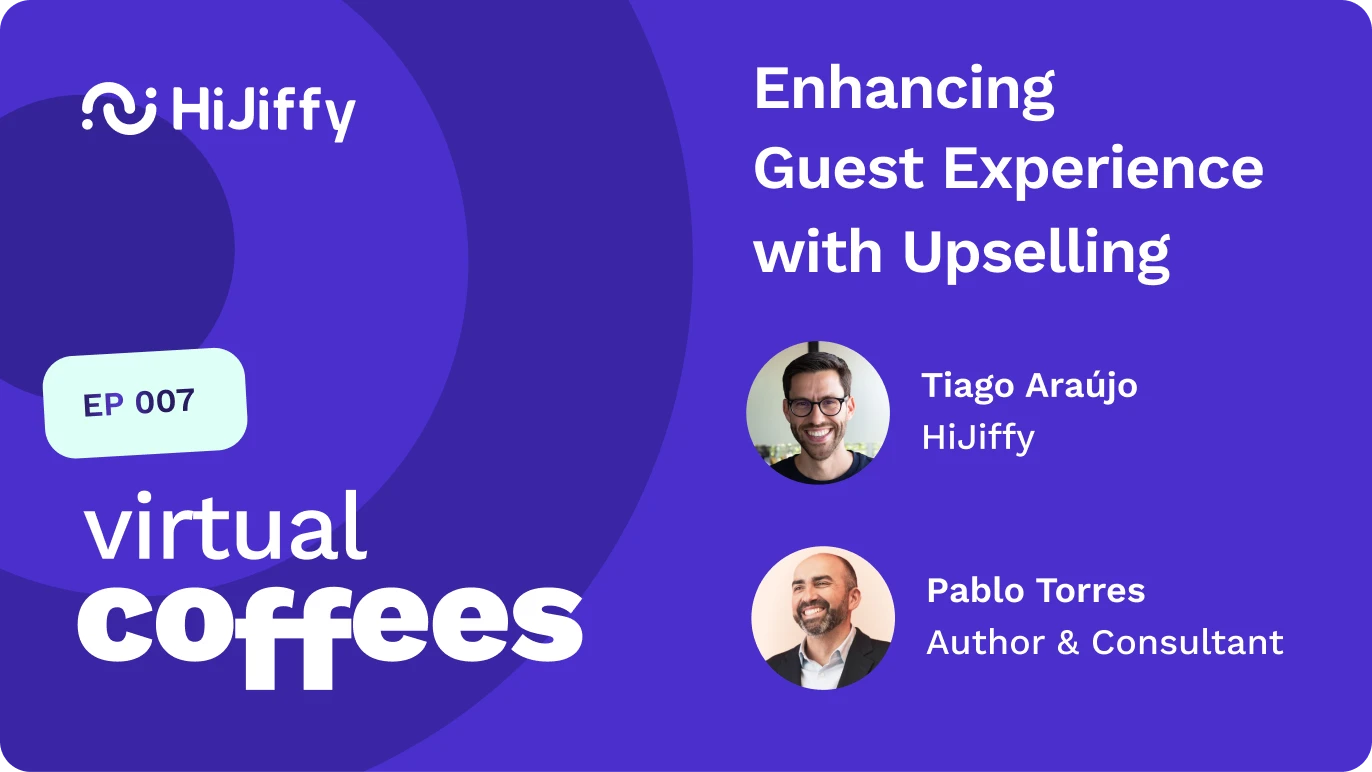
In this episode, Tiago Araújo sits down with Pablo Torres, a hospitality expert with 25 years of industry experience and author of Mastering Hospitality and Ancillary Revenue, to reframe how hotels approach upselling. Pablo makes the case that upselling is really about uncovering needs guests already have and improving their stay, why the mindset shift has to start with management, and where in the guest journey it makes the most difference. He closes with practical steps: hire for it, train for it, and incentivise the whole team.
Transcript
Tiago Araújo (00:00): Hi everyone, we’re here for another Virtual Coffee. Today we have Pablo Torres with us. First of all, I’d like to thank you, Pablo, for being here with us.
Pablo Torres (00:14): Thanks, Tiago, for having me. It’s my pleasure.
Tiago Araújo (00:17): To give it a kick-start, would you like to introduce yourself, whatever you find relevant for the audience of hoteliers listening to us?
Pablo Torres (00:27): Well, again, thank you for the opportunity. I’ve been working in the hospitality industry for 25 years. That’s all I’ve done in my life. Half of it was working in hotel operations, mainly in rooms and revenue. And then, 14 years ago, I moved into training and consulting. So I’ve been fully dedicated to training and consulting hotels, mainly on ancillary revenue and how to optimise ancillary revenue for hotels globally.
Tiago Araújo (00:55): Awesome. And you did something that’s a dream for a lot of us: you’ve written a book. I’m sure there are still many things to do in life, but that checkbox, you’ve already got it done. I’d like to go immediately to your book, the one you launched in 2024, Mastering Hospitality and Ancillary Revenue. One thing I was curious about, Pablo: since 2024, a lot of people have read it, and a lot of people have given you feedback. What was the most insightful feedback you got from people who read it?
Pablo Torres (01:32): I think it would be the fact that a lot of people see upselling with rejection. A lot of people see it purely as selling, and not everyone is a natural-born seller, so it’s not something they do proactively. But then they realise the way I show it in the book, which is the way I see it personally: upselling is improving the customer’s stay, making sure their needs are covered. A lot of people see upselling, upselling, cross-selling, any ancillary, as trying to get their hand in the guest’s pocket. That’s wrong. As trying to create needs, again, that’s wrong. The needs are there. It’s just that sometimes customers don’t realise they have those needs. So your job as a waiter, as a receptionist, as a spa therapist, is to make them realise you can help them cover the needs they didn’t realise they had.
For example, a family need extra space in the room. They might not realise the room they booked doesn’t fit, that it’s not the best for them. So it’s your role to let them know. When people read the book and realise it, they change their mindset, understanding: okay, the whole point of this is trying to add value, trying to improve the guest stay, so that they leave the hotel more satisfied, having spent more money. And that’s what changes the mentality of people.
Tiago Araújo (02:51): Yeah, it’s nearly like a win-win situation, because it’s a better guest experience on the guest side, and obviously more revenue on the hotel side. So it’s win-win. Everyone wins here.
Pablo Torres (03:05): Exactly. And then, if they incentivise the team, which should be the ideal scenario, it’s a win-win-win. So the guest is more satisfied, the company is making money, and the team is motivated because they’re also getting part of it.
Tiago Araújo (03:17): Sure. And what do you think is the biggest blocker to implementing this AI-driven upselling successfully? Do you think it’s technology, data quality, the mindset of the teams? What would you find as the biggest blocker?
Pablo Torres (03:34): So, it starts with mindset. And then there’s a link between data and technology. Mindset, as I mentioned, is everything: understanding how to establish it. A lot of hotels see upselling as a departmental thing. “Okay, reception, organise your upselling; waiters, F&B, try to do whatever you can,” but it’s not done from the management or senior management point of view. It’s just left to each head of department to run their own department. If you get that view from above and say, “Okay, I want to structure a proper plan for each different department, but run operationally from above,” helping them and structuring the processes and incentive plans, then it helps a lot.
And then, when it comes to data and technology, the challenge with hotels historically is the poor use of data. Every hotel has millions of data points. Every check-in leaves you lots of information from the reservation, lots of information from the ID or passport that’s stored. Legally, you have to store that information, but it’s stored for what? Many hotels don’t use it for anything. It’s just stored there, gathering dust in a cloud nowadays. So if you have the right technology to use that data to improve the way you service your customers, you’re going to improve the life of your receptionist, in this case, because a lot of very mundane tasks can now be automated, so they’ll have more time to dedicate to their customers, which is the most important thing.
At the end of the day, hospitality is about taking care of customers, but most of the time is spent typing stuff, creating reports, punching in numbers. I had a customer relations person once telling me, “I don’t have time for customers.” I’m like, “You are the guest experience. What do you mean?” And she said, “Oh, I have to fill in all these forms and prepare all this data and review the online reviews, so I really don’t have time to talk to customers.” There is something very wrong there. So it’s about making sure the technology you have has the ability to utilise the data, and then you come and provide a better service.
Tiago Araújo (05:43): Yeah, all of us tech providers always need to think about this step, of taking the eyes and the head of hoteliers away from facing the laptop, right? Always looking into the laptop instead of speaking with a guest and spending time with the guest, because that’s the biggest differentiation. Something interesting you mentioned there, in terms of mindset, is that you’re talking about the upper level and not operations. So within your trainings, and I know you train people too, you don’t find any blocker in terms of the operations people who work, for example, front desk, not wanting to upsell? You’re more worried about the upper level, in terms of the mindset of how upselling can be important for guest experience and revenue, as we were talking about?
Pablo Torres (06:31): Yeah, because they’re the ones deciding, at the end of the day. Operations need to finalise the action, but the ones who are going to decide how to implement it, when, what kind of input is going to be put in there, the resources involved, the incentive for them, is going to be the management. So it’s about showing or resolving the pains that each person has. If it’s revenue, we’re going to talk about the revenue impact, the RevPAR or TRevPAR increase, for the hotel’s overall results. If it’s the GM, it’s going to be the ROI of the investment: “It’s going to cost you this much, but hey, you’re going to get an ROI of 10 times, 25 times what you invest.” And once that’s decided, then it’s easier on the operations part, because as soon as you show the team how much incentive they can be making, it’s about the technique and how to implement that suggestive selling within the check-in, or the waitressing, or the therapy, whichever role they have.
Tiago Araújo (07:28): Yeah, as you were saying, management decides two things: the incentives, for sure, and the tech they hire too, which has a huge impact. But you were mentioning something else too, you were already talking about the guest journey. So within the guest journey, where do you think upselling has a bigger impact? Is it pre-arrival? Is it during the stay? I don’t think it has a great impact post-stay. I don’t know if you have any ways of upselling post-stay, but within this guest journey, where do you think it fits?
Pablo Torres (08:03): I think the main homework is pre-stay. It’s where most potential is. And there’s usually a lack of engagement from hotels when it comes to pre-stay. I heard once a very seasoned sales manager from Mallorca saying, “Well, listen, most of our customers come through wholesalers from Germany or the UK, and they might book at Christmas for next summer.” Now, between Christmas and the summer, those six months, they get six to seven emails from the wholesaler: information, upselling, cross-selling, extras. So it’s this circle, and they end up spending more through the wholesaler. Then the first time the customer has any contact with the hotel is going to be at check-in.
So in this scenario, there’s nothing really you can do, because the information is owned by the wholesaler. But for direct sales, or the second time the customer comes, when you already have the data, there has to be a much bigger effort from hotels to contact customers. I think that’s a very large missed opportunity for many hotels, that they still believe the first-time contact is the check-in. Check-in, yeah, it can be improved, there’s more opportunity there. And then after departure, it’s mostly about loyalty. I’ll link that to what I said earlier about data. You have emails, names, and addresses from every single guest. So besides the automated happy birthday email you send to every customer, is there anything else you do? Are you trying to build loyalty? Do you send any informative newsletter? Are you trying to add value to those customers, so that next time they dream about holidays, you are top of mind, because you’re reminding them how nice you are? Because usually it doesn’t happen.
So again, we’re breaking that cycle, hotels. So many hotels focus only on check-in to check-out. But if you manage to stay in the guest’s mind throughout the 365 days of the year, eventually they’ll come back to you and reward you for the loyalty.
Tiago Araújo (10:03): Awesome. And to sum up, Pablo, basically, if we have a hotelier listening here and they’re really engaged with what you’re saying, they really want to improve upselling next quarter, what would you say this person should focus on?
Pablo Torres (10:19): I’d ask them to do their numbers. Okay, how much are you making? Most people do some sort of upselling. What’s missing very often is either the structure or the training for the team. You can’t just assume that your team that has been with you for 20 years is suddenly going to magically start selling. So if you have some sort of turnover within the team, the first step will be to include upselling in the hiring process. Let them know that when you’re hiring new people, you’re expecting them to sell. Again, it doesn’t matter which department. And then in the interview as well: check with them, test them, role-play. So that when they start on the team, you can rely on the fact that, hey, you have the skills already in there. And then train the team and establish a process. But the key thing there is not assuming that everyone can sell, because that’s not the case. So you should sort of audition for people who have those skills.
And then incentivise. I still see a lot of rejection from management when it comes to incentivising, and I was thinking, “Wait, so you have a sales team whose only role is to sell, and you’re giving them a bonus. But you have reception, whose job wasn’t selling, you’re asking them to sell, but you give them nothing. How does it work?” It doesn’t. So it’s about trying to make them understand that if you give a little, they’ll give you a lot.
Tiago Araújo (11:48): Sure. Thank you so much. Very insightful, Pablo, as always, as we’ve been discussing a lot of times together. I think that, in a nutshell, mindset and tech are the biggest highlights of my conversation with you. Thank you, Pablo.