




Introduction
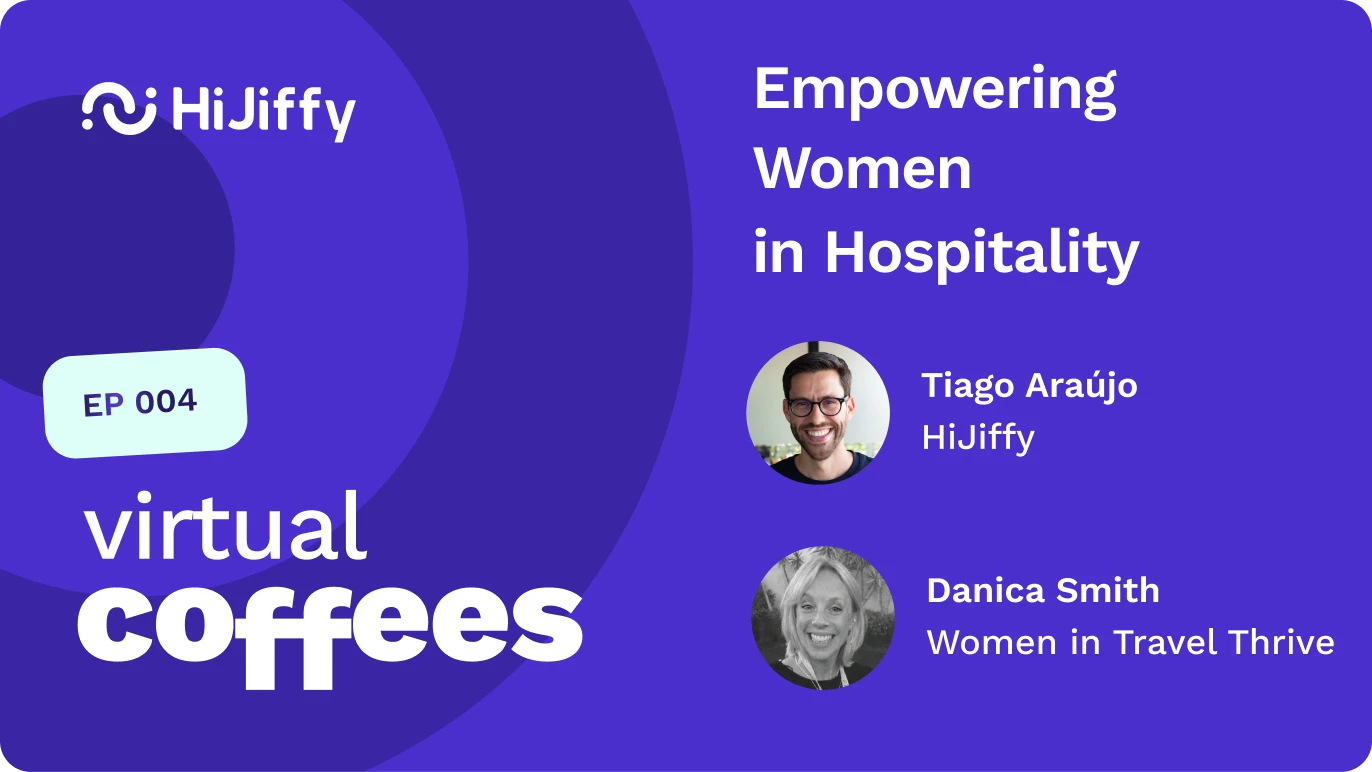
In this episode, Tiago Araújo sits down with Danica Smith, guest experience advisor, host of the Hospitality Daily podcast, and board member of Women in Travel Thrive, for one of the industry’s most important conversations: empowering women in hospitality and building real pathways to leadership. Backed by the data and her own experience, Danica talks through the barriers that persist, from visibility and the confidence gap to the hidden mental load, and why treating maternity leave as taboo helps no one. It’s a candid look at how transparency, mentorship, and male allyship can make careers in hospitality more inclusive.
Transcript
Tiago Araújo (00:01): Hi everyone! We’re here for my next Virtual Coffee. Today we have Danica with us, and I’ll pass her the mic to introduce herself. Go for it, Danica.
Danica Smith (00:13): Thank you very much. I’m so excited to be here. My name is Danica. I’m a guest experience advisor, with one hat on. I’m a guest experience podcast host at Hospitality Daily, I’m a Gain advisor, so I work with technology vendors and operators, and I’m a board member of Women in Travel Thrive. So I have a lot of these conversations, Tiago, to raise awareness of women in leadership. I’m really grateful to be here today!
Tiago Araújo (00:40): And thank you so much for accepting my invite right away. As we were talking off-camera, you’re travelling right now, so again, thank you for still joining me for this Virtual Coffee today. Today, we’re going to talk about a topic I’m really into. Obviously, as a man, I try to do my best, but I still have a lot to learn. That’s about empowering women, and in this case specifically in the hospitality industry, building pathways for leadership and growth. I know it’s a topic you’re very familiar with and very into. So I’ll go for my first question. I use these Virtual Coffees a lot to actually learn from people. It’s a bit of an individual thing for me, giving time throughout the weeks and months to take this break and learn. I wanted to know, from your perspective, what are some of the biggest barriers still holding women back from leadership roles in the hospitality industry?
Danica Smith (01:59): Yeah, it’s a great question. First of all, just as a side note, thank you so much for being such a visible ally. This whole topic is quite heavy. I don’t think anybody has the right answers, and this is what it’s about: just having conversations, opening up the floor to shine a light on it. So, side note.
But when it comes to the barriers to leadership in hospitality, let me give you some statistics. In hospitality, women make up 54% of the global hospitality workforce, yet at executive level it’s less than 20%. When we look at hospitality technology, unfortunately it gets worse: women hold less than 15% of C-suite roles. So I think one of the biggest barriers is visibility. I noticed this myself as a young, ambitious tech leader. I looked around and there were zero CEOs in hospitality technology around me, there were zero founders, zero CROs. And when I came across a female leader, she would be VP of HR, VP of marketing, and didn’t even have that C-suite role. So I think the first part is visibility.
And then, as we get into it, confidence. There’s lots of data around this: a man will apply for a job when he has 40% of the skills, because he’s ready to take that transition, while a woman will wait until she has 100% of those skills before she applies. So, yeah, as we get into leadership, the roles are less there and there’s less visibility. And so women maybe think, “I can’t become that CEO of the next new tech startup in hospitality.”
Tiago Araújo (03:47): Completely. And that’s a really good one. I actually have a book to recommend later about data and women. You have a lot of that data you just mentioned; probably you’ve already read it. But why do you think this actually happens? The data is there, as you mentioned, and it’s something I’m very familiar with, unfortunately. HiJiffy is a case of that: three founders, three men. In terms of leadership, things have been changing. We’re nearly half-half now in terms of leadership. In the past we were not. But why do you think it happens? I already know that data too, that women always wait to have all the skill set that’s needed and men risk it. In your opinion, is it something to do with childhood, where we receive a lot of education where little girls need to be very careful and cautious of what they do, and little boys can play around and get dirty? Is that the case, and is that where it comes from, from the foundation? Or do you think that hotels, travel brands, and tech companies in the hospitality industry, is it something we can do better and differently? Or is it actually both A and B: it comes from the foundation, and companies can do more?
Danica Smith (05:25): Yeah, I think it’s such a complex conversation, such a mix of so many different elements. I have a five-year-old and a six-year-old, a boy and a girl, and the way my husband and I parent them, even though I’m so conscious of this, is so different. “Be careful of the tree,” and “Go and climb up the tree.” “Be careful, you might fall.” So there’s so much of this subconscious bias ingrained in us. The evolutionary side, I don’t know, that’s a separate conversation. But when it comes to what we can do now to change the now, look, it has got a lot better. If you talked to some female leaders 10 years ago, those numbers were sitting at 5% or 6%. So there has been growth, not at a fast enough pace in terms of leadership. And we haven’t even got into the pay gap either, which is a huge problem for me, the most frustrating.
But when it comes to the why, the confidence issue is part of it. Like I said, the visibility and the belief. I’ve been very lucky in my life to have really amazing mentors, both male and female, who have proactively elevated me. And I think if you’re a mid-management female, and I’m talking on behalf of my colleagues and friends and generalising, okay, but I think a lot of women might think, “I could never become that CEO or that CMO. I’m a marketing manager, I can’t see myself there, maybe in five years’ time, but not in two years’ time.” And I think a really good action leaders can take is to take that manager aside, take her for a breakfast, and talk about her career progression. Say, “Listen, you’re doing amazing. I think you’ll be ready for this position in 12 months. Let’s work together to get you there.” Plant that seed of ambition, that you absolutely can be there. And once that confidence grows, then they’re going to apply. So it’s not even in their thought process that they could have those roles.
And then, as we were talking offline, the conversations of workload, motherhood, household, the mental load a woman has. Even though we’re 50-50 in the workplace now, that’s not the same in the household. Me and my girlfriends always laugh when it comes to birthday parties or Christmas: the men have no idea how the presents just miraculously arrived. So it’s that mental load as well. I think there’s a lot of burnout when it comes to women in leadership too, which is a huge topic and problem that we don’t talk about enough.
Tiago Araújo (08:12): That’s one of the elephants we always have in the room, I think, that companies aren’t talking about that much. We were talking offline about the challenge HiJiffy had with so many maternity leaves. We had eight maternity leaves in a timeline of six to 12 months. How do you see that in terms of career progression too? Because obviously it always has an impact. A lot of the time what happened at HiJiffy, we were lucky enough to be growing so much and have space for people to continue growing, and even job changes happened after maternity leave, with people wanting to say, “Okay, now I’m a mum, but it’s not all about the baby, it’s about me. I need change and I need to change my job completely.” But most companies aren’t growing, or are growing slower, and there’s no space for that. So, in terms of maternity leave, it’s always the elephant in the room, people not wanting to touch it, because we’re very lucky legally; most Europeans are protected. But how do you see that impacting career progression?
Danica Smith (09:25): Yeah, I think it’s a great question, and it’s a topic that’s quite taboo, both from the employee and the employer side. I think it’s important that we just create this space. Commercially and strategically, as a tech startup or a tech company growing aggressively, to have eight members of your team out at once has a huge negative impact on the business. That’s huge. And it should be okay, as a founder, in my personal opinion, to have that conversation and be very transparent. It’s not blaming, it’s not shaming, but I feel like male leaders certainly are so nervous to even approach that topic, of how it might land. And so it becomes a taboo issue, and then it becomes the elephant in the room. We’re not working at large corporations, we don’t have clear policies around this, so it’s about just having open and honest conversations.
I was incredibly lucky, and this is where male allyship really comes into this conversation. Neil James, my boss, I was on maternity leave with my second child and I got promoted while I was on maternity leave. So I was off for a year, and I came back to a team of eight and a new position, and I hit the ground running and we made it very successful. Now, that to me was amazing, but actually the message that gave to the rest of the company, and Neil and I now talk about this on many leadership panels, was a very powerful message to females: you can take that time out, you can have your baby, you can take the year off and be in that bubble, and you can absolutely come back and progress and grow. There are a lot of difficulties, it’s very difficult to juggle those balls, just like it is as a male.
We’re very lucky in Europe when we have the paternity rights. So I actually don’t see it so much in Europe; in the UK and America it’s obviously totally different. Whether it’s maternity or paternity, there is this juggle and this guilt of, “I feel like I’m letting down the company.” Whereas I think if you have that space of, “Okay, you’re off, this is amazing, so happy for you, what are we going to do? Because these are the gaps that we’re missing, and how can we fill those gaps? What’s the best route forward?” So it’s open dialogue. It’s always the right way. And my advice to founders and leaders is: don’t be ashamed of being really transparent about the negative impact your superstars being out of the business for a year can have. That’s okay. Have those conversations and come to a solution together. Because I guarantee the female who is pregnant has already thought about what’s going to happen to her role. She’s probably already got a strategy for how she can manage it. Just have those conversations.
Tiago Araújo (12:22): Completely. We were lucky too. There were two people who came back from maternity leave and were promoted with a bigger team. So exactly the same as you mentioned, it happened at HiJiffy. I think one point you mentioned that’s very, very important is the mindset. Especially mums with their first child, the mindset that people come back with, and the company needs to respect that. And I’m not just talking about mums, dads the same thing. It’s a very important moment in the timeline of someone’s life, and it happens that people change their ambition and their priorities in life. And that’s basically where the company needs to respect it. I totally agree with you.
In a nutshell, summarising a bit, I’d say the major takeaway from this talk is around having conversations. Just being super transparent and talking about things. I do agree with you on one point: yes, in Europe things are very well protected legally. There’s something in the UK you guys have that I would love to have in other countries where we have employees. In the UK it’s very natural or normal for you to do a cover for a maternity leave. In Portugal and Spain, as you know, or even France, it’s not that common to have people applying to cover a maternity leave at all. And I know that in tech companies, even that is very, very difficult, for people to ramp up and know the products, whatever the role they have. But I would love to have that.
Danica Smith (14:14): One day. And on that point, though, you’d rather have your best star employee out of the business fulfilling her dreams and doing good for humanity than having a disengaged, crappy employee who just turns up and does nothing. So, yeah.
Tiago Araújo (14:30): Sure. And those are the difficult ones to catch and to maintain in a company.
Danica Smith (14:35): Well, keep doing what you’re doing, Tiago, and you’re going to get the right ones. Because, like I said, the visibility, the support, the conversations, this today, of course, everybody would want to work for HiJiffy. So you’ll get those stars. Keep having the conversations, and we’ll slowly make change that way, together.
Tiago Araújo (14:54): Thank you so much for joining my Virtual Coffee.
Danica Smith (14:58): Thanks for having me. I hope we can come back for part two!