

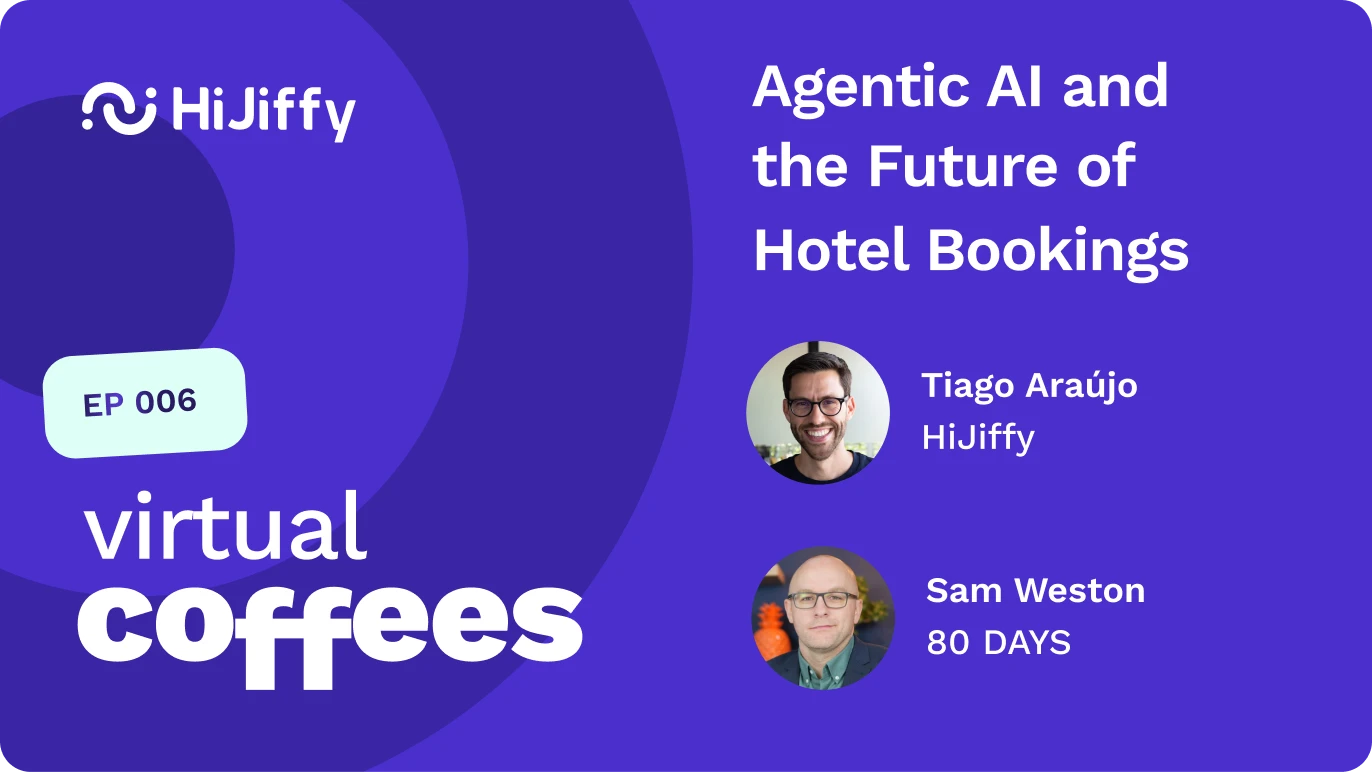


In this episode, Tiago Araújo talks with Sam Weston, Head of AI and Marketing at 80 DAYS, about how AI search and agentic browsers are changing the role of the hotel website. Sam explains what it means to optimise for machines as well as humans, why hotels should test-book their own sites with tools like Atlas and Comet, and how this shift could be a leveller that puts independent hotels back on the shortlist against the OTAs. A grounded, forward-looking take on where discovery and booking are heading.
Tiago Araújo (00:00): Hi, Sam. First of all, thank you so much for joining me in one of my Virtual Coffees, and welcome.
Sam Weston (00:08): Thank you. Good to be here.
Tiago Araújo (00:11): Do you want to give a quick introduction about yourself before we start?
Sam Weston (00:15): Sure. My name is Sam Weston, I’m the Head of AI and Marketing at 80 DAYS. 80 DAYS is a full-service creative and digital agency that specialises in hotels and travel. And we work, obviously, with HiJiffy as a partner.
Tiago Araújo (00:29): Awesome. Today we’re going to talk about something very, very interesting. Even for us at HiJiffy, it’s something we’ve been working on as a product for a whole two years, improving and optimising what was more related to SEO, but now more to LLMs. How, when people ask what’s the best chatbot in the hotel industry, we actually show up there. It’s something interesting I saw the other day in a post on your LinkedIn, where you talked about how AI search and AI agents impact the role of hotel websites. You mentioned something our Marketing team wrote about not long ago, about AI agent optimisation. What would you say has changed for hotel marketeers when they start optimising for AI agents instead of optimising for humans?
Sam Weston (01:35): It’s a good one. And I’ll try not to speak in acronyms, because it’s just another acronym in the industry, right? We’ve got enough of them already. I think it’s a really interesting one. Fundamentally, I think it’s just a shift in thinking, really. Traditionally, the hotel website acts as a tool to inspire guests and showcase your hotel in the best possible light, with the best possible imagery and photography, et cetera, with the end game of getting a human to click that “book” button. Now, the role of that website is expanding. We need to factor in the clarity of information and data that lives on a hotel website, so it’s really structured and these AI agents can successfully interpret and navigate it, and even book on a hotel website itself.
I’ve been playing around with it myself, toying with it. Quite an interesting thing to do as a hotelier is to go to one of these agentic browsers, like Atlas from OpenAI or Comet from Perplexity, and ask it to go ahead and book a room at your hotel on your website, and just see how easily, or not, it can do that. Because it’s impressive how it can work around the issues and problems it might have while navigating around your site. I found an example the other day where it was stuck on a date picker, it couldn’t find a date on this hotel website, but it managed to work around it. It’s incredible to go ahead and make that kind of booking.
So I think that’s the shift. It’s this shift in mentality, to optimise for both humans and machines. And I think the real key is actually trying to speed up that process as well. Trying to book on a hotel website via agentic AI right now takes two or three minutes. It’s a fairly slow process. But I think the aim of the game is really just to set up a website so that an AI agent can go in there and make a booking in under a minute. And then, when we’re talking about going to events like ITB, we can go in there and say, “Right, show me the best hotels near Berlin under 200 euros,” and it can go through that whole process of showing you the hotels, selecting one, and then going on to actually make a booking and check availability on your behalf. I think that’s going to be impressive.
Tiago Araújo (04:04): That’s very impressive. One thing I was recalling while you were talking, to recommend to hoteliers, that I find very nice: when searching for your hotel, trying to see the sources the LLM is taking that information from. I find it super interesting when you see the source is a specific part of the hotel’s website that’s giving that quick information, even for frequently asked questions, using the LLM for what time is check-in, or does this hotel allow pets, or whatever. I find it very nice when I see the source is the hotel website and not an OTA, Booking.com or Expedia, and that having an impact. Another thing I find interesting about what you were mentioning: I’m not sceptical, but I still want to see the next few years in terms of LLMs, as you were mentioning, or having Atlas, for example, and someone booking through there. I still see the importance of booking engines. Why do I say this? Because normally, naturally, when we’re a guest and we’re booking, what happens is that in some hotels, not all, we have a lot of rooms, different kinds of rooms. And within the different kinds of rooms, a lot of fares: free cancellation, breakfast included, et cetera. And here comes someone who’s selling AI for hotels, but I’m not sure yet that that’s the best place for the booking process. Probably in the next few years the LLM will already understand that I normally always book free cancellation with breakfast, and the kind of room type. I don’t know. I don’t know.
Sam Weston (05:57): Yeah, I think it’ll be learning, right? It’ll learn your booking behaviours. But yeah, Sam Altman’s pretty optimistic that you can go end-to-end, search and book within ChatGPT, with his bullish claims, probably by the end of this year or very soon. I think that might be a little bit further away than that, because it’s fine for e-commerce where you’re buying one product and it’s dispatched to you and everything’s fine. But a hotel room, as you say, is a far more complex purchase. So I think it’ll be a little bit of time before we get to that stage. I don’t think it’s about “if.” I think it’s more like “when” it will happen.
Tiago Araújo (06:38): Sure. Because in the foundations of HiJiffy, we started with you being able to book through the chatbots without redirecting to the booking engine. And then we A/B tested with redirecting to the booking engine, and we saw a spike in conversion rates. The assumption we made at the time was that people looking into different room types, free cancellation, breakfast included, all of that, is something people still need to see the various options for. And at least for us, having a small chat on the websites, we didn’t find that was the best place to give all those options. But obviously Atlas is a completely different thing, as you have a full screen. It’s a completely different experience.
Sam Weston (07:27): Which is interesting as well, right? Because you’ve got OpenAI and Jony Ive and what they’re doing. What is it, a voice AI? Is it going to have no screens? Is it going to be a kind of souped-up Alexa effect, effectively? And that’s fine, but I personally can’t book, I can’t see myself booking a hotel exclusively through something like that, because I need to see the room. I need to see the room at the end of the day. So I can see technologies like that working well, being integrated with smartphones and things like that. And when you get to the point of being able to make a booking and it pushes a room shot, an image of what you’re going to book, to your phone. But I can’t see it completely replacing screens, like the technologists may be prophesising. I don’t think that works for me. We’ll see. I’ll probably be proven wrong.
Tiago Araújo (08:16): True. Me too, same, completely.
Sam Weston (08:19): Ha ha!
Tiago Araújo (08:19): And who knows, who knows. Sam, to wrap up, what excites you the most about this shift, and what actually worries you at this stage?
Sam Weston (08:32): It’s a good question. I find the whole topic of AI exciting, so there’s that. But I think generative AI, and even agentic AI, has the opportunity to be a really good leveller for the playing field, certainly for independent hotels. Because I think they’ve gone a long time battling for direct bookings with OTAs, and this technological shift could be a chance to try and reclaim some battleground there. Even if Glenn Fogel and Booking.com would disagree. I think maybe they’re a small bit worried.
You look at traditional search, and search “five-star hotels in London,” for example, and it’s really hard for the traveller to make a booking from that, because it’s all non-branded, it’s all OTAs, it’s all third parties. But on a large language model, it’s a shortlist of five to ten hotels. So all of a sudden the hotels have a seat at the table again. And I think it really is just about the next stage of that, trying to feed rates and availability in there. That’s what we’re trying to do here at 80 DAYS, with a partnership with Direct Booker and DerbySoft, in terms of feeding rates and availability, and a very important book-direct link as well, within the feed on these large language models like ChatGPT, Gemini, and Claude. Because down the road, I think that could potentially be really game-changing for hoteliers. The OTAs won’t roll over, they’ll have a way to make sure they’re featured as well. But I think it has the opportunity to be really positive for the independents.
On the converse side, what scares me most, I think, is the fact that the online travel agents have exceptionally deep pockets. And the other factor as well, they have so much data in their repositories. So I think there’s a battle to be had in the data game as much as there is in terms of the budgets. But yeah, that’s what we’re trying to do, help to champion the independents, to get back in the game a little bit.
Tiago Araújo (10:43): It’s a very valid point. And you were mentioning OTAs, and companies like OpenAI testing with individual independent hotels versus testing with an OTA. It’s a difficult choice, where you can plug and play with an OTA that has so much availability and so much data, as you mentioned too. But still, just as when booking started online, now booking is going through LLMs like ChatGPT, it’s truly the time that independent hotels need to be aware of this, and not let happen what happened from an e-commerce perspective, with OTAs going way ahead and hotels not being that worried about direct bookings at the start. And now is the time.
Sam Weston (11:40): Yeah, totally. And if Glenn Fogel is calling it out on an investors’ call, maybe he is a little bit worried, you know, underneath. We can hope, from fighting the independent fight, we can hope.
Tiago Araújo (11:53): For sure. Thank you so much, Sam, for joining this Virtual Coffee.
Sam Weston (12:00): No worries, it’s really good fun. Thanks.