Only 5-star hotels have to staff reception around the clock. For most hotels, a 24-hour front desk is a choice. The right call (resources and staff shortages aside) depends on what your guests need between the evening and the morning, and who covers it when nobody is at the desk.
Automated messaging, chatbots and self-service processes can cover the routine scenarios, but access problems and emergencies still need a person who can reach the hotel within minutes. This guide helps you reflect on where that line sits for your hotel, what it means for your star rating and OTA listings, and how to set up night cover without a 24-hour reception.
The examples in this guide come from our conversations with hotels, part of the 2,600+ we work with worldwide. We’ve kept their names out but their situations in.
A 24-hour front desk (or 24-hour reception) means a staffed reception at every hour of the day: a person at the desk, not just a phone number or a key box.
Three things often get confused under the same label:
24-hour front desk
Someone is in the reception area around the clock.
24-hour check-in
Guests can check in at any hour, which may mean a person, a self check-in kiosk or a code for a key box.
24-hour assistance
Guests can reach someone at any hour, by phone or message, who may not be on site.
Guests notice the difference. Booking.com lets them filter for hotels with a 24-hour front desk, which makes that label a promise of the experience guests choose.
Most night-time requests and needs fall into five groups, and only some of them need a person on site.
| Need/Request | Can it wait until morning? | What covers it |
|---|---|---|
| Routine questions (breakfast time, Wi-Fi, parking, check-out) | No, but it doesn’t need a person | Written information, pre-arrival messages, automated answers |
| Late arrival and access (keys, codes, finding the room) | No | Clear instructions sent in advance, plus a person reachable if they fail |
| Requests during the stay (towels, a noisy neighbour, the heating) | Some can, some cannot; the sooner they can be addressed, the better | Messaging with someone who can act, or a note for the morning team |
| Booking enquiries from future guests, often in other time zones | Not really: they may book elsewhere | Automated answers and a booking engine that works at night |
| Emergencies (medical, fire, security, a guest locked out) | Never | A person reachable within minutes, emergency numbers, a tested procedure |
Arrival is the top concern at any hour. In HiJiffy’s analysis of 1.7 million guest conversations from summer 2023, check-in was the most asked topic of all (Top 50 questions asked by hotel guests). Most of those questions can be answered automatically, or the information can be provided proactively before guests need to ask.
Hotels underestimate booking enquiries. One of our clients told us on initial calls that because its reception isn’t staffed around the clock, out-of-hours enquiries go unanswered and turn into abandoned bookings (if that pain point sounds familiar, take a look at our Automated Booking Recovery feature).
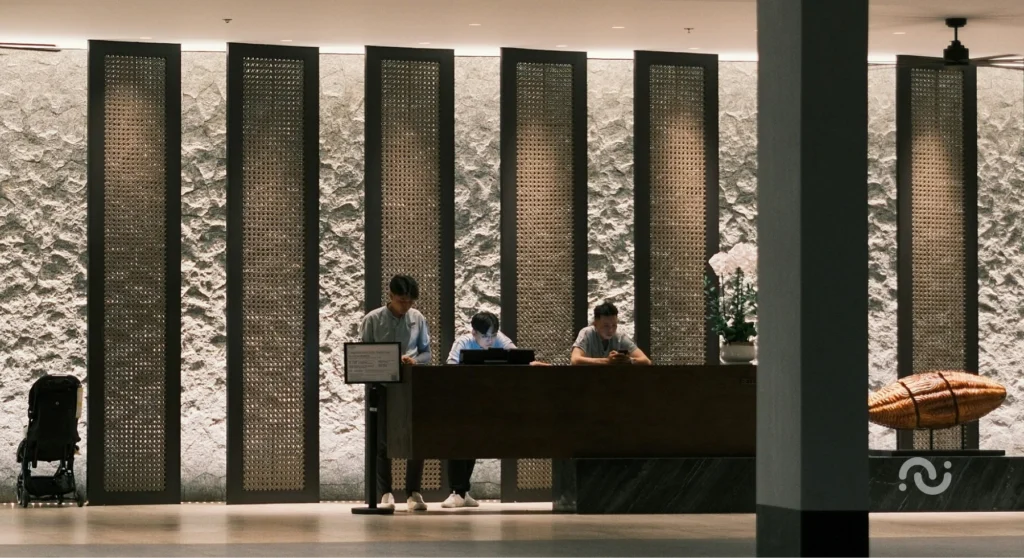
No single alternative replaces a night receptionist, but providing that cover is often beyond hotels’ capacity. That’s why hotels explore and combine options, each covering some needs and missing others.
| Option | Routine questions | Late arrivals | Requests | Emergencies | Watch out for |
|---|---|---|---|---|---|
| Night receptionist | Yes | Yes | Yes | Yes | Cost, hiring, one person for everything |
| Night porter or night manager on site | Mostly | Yes | Yes | Yes | Often also covers security and the night audit; languages |
| Staff on call by phone (on site or nearby) | Partly | If they answer | Partly | Yes, if they can reach the hotel fast | Calls missed while asleep; travel time |
| Outsourced answering service or call centre | Partly | Partly | Can take a message | Can escalate | Scripts, languages, no access to the building |
| Self check-in (kiosk, key box, digital key) with written instructions | No | Yes, when it works | No | No | What happens when the code or card fails |
| Messages and automated answers (pre-arrival, chat, WhatsApp) | Yes | Instructions only | Can collect and route | Can route to a person, not act | Needs accurate content and a person behind it |
The gaps show up in practice. A client hotel told us its night shift runs on a single emergency phone, so evening messages go unseen. Another’s after-hours call centre isn’t available all night and only speaks English. Languages matter more at night than hotels expect, and paying for multilingual night shifts raises staffing costs.
Two other jobs leave with the night receptionist. The night audit, the end-of-day close in your property management system, needs an owner, or your system needs to run it automatically. Someone also needs to be responsible for the building’s security overnight.
Post-check-in messages help close the gap for in-house guests. Kabannas introduces its chat in a welcome message after check-in, as the channel for help at any hour, so guests know where to ask before they need to.
The hotel sets its working hours. Outside those hours, the AI answers routine questions via webchat, WhatsApp, email, voice, and messaging on Booking.com, Expedia, and Airbnb. It answers only from the hotel’s own Property Knowledge Document, so it won’t make up a cancellation policy at 03:00. When a guest needs to speak to a person, and nobody is on shift, they get the hotel’s after-hours message, with the emergency number, instead of silence. In the morning, the team finds the night’s conversations in one inbox, prioritised by sentiment, so staff can deal with the most pressing issues first.
In most cases, no. But dropping the night desk can cost a 5-star hotel its category, take you out of a Booking.com filter and break a promise you’ve already made to booked guests. Check all three before you change the shift.
Star rating. In the Hotelstars Union member countries, the 2025–2030 criteria set reception hours by category (Hotelstars Union classification criteria 2025–2030):
| Category | Reception requirement |
|---|---|
| All categories (1 to 5 stars) | 24-hour guest assistance available digitally or by phone |
| 1 and 2 stars | 8 hours of physical availability in the hotel, or 24-hour self check-in and check-out |
| 3 stars | 10 hours of physical availability, or 8 hours plus 24-hour self check-in and check-out |
| 4 stars | Reception staffed 14 hours, and someone physically available 24 hours on request |
| 5 stars | Reception staffed 24 hours |
“Physically available” means a responsible person on site and within close walking distance. For 1 to 3 stars, the core opening hours must be shown on the website or the booking confirmation. So a 4-star hotel can close the desk at night, as long as someone on site comes when called. A 5-star hotel can’t. Outside the Hotelstars Union, including Spain and Portugal, national and regional systems set their own rules.
OTA listings. “24-hour front desk” is one of the facility filters guests use on Booking.com, and it can appear as a highlight on a hotel’s card in the search results. If your night cover changes, update two things in the Extranet (Booking.com for Partners):
Arrival details that don’t fit those fields go in the fine print, and Booking.com suggests repeating them before arrival through guest messages.
Guests who have already booked. Some chose you because of the 24-hour front desk. Tell them what changes and how late arrivals will work before they travel.
When nobody is at the desk, the late-arrival message does most of the work at the door. Send it the day before arrival, and again on the day if the guest confirms a late arrival.
It needs to answer every question a guest could have at the door, in order:
Typing instructions and door codes into WhatsApp one guest at a time is slow and easy to get wrong. Put the code in a template, send it close to arrival and only to the guest, and change it after check-out.
Hi [first name], we’re looking forward to welcoming you [tomorrow / today]. Our reception is open from [time] to [time]. If you’re arriving after [time], here’s everything you need:
Breakfast is from [time] in [place]. See you soon.
For more pre-arrival wording, see our hotel welcome message templates.
Automated answers and written instructions cover the routine. They don’t open a door that won’t open, and they don’t help an ill guest in the middle of the night.
Before you drop the 24-hour front desk, have this minimum in place:
A useful test for your team: a guest arrives at 01:00, and the code doesn’t work. Walk through what happens, minute by minute. If the answer includes “they call, and nobody picks up”, you’re not ready to drop the night desk.
It means the hotel’s reception is staffed at every hour of the day, with a person at the desk. It’s different from 24-hour check-in, which can rely on a kiosk or key box, and from 24-hour assistance, where guests can reach someone by phone or message who may not be on site.
Not usually. Under the Hotelstars Union criteria, only 5-star hotels need a reception staffed 24 hours a day. 4-star hotels need a reception staffed 14 hours and someone on site who comes when called at any hour, and every category needs 24-hour guest assistance by phone or digitally. Local fire-safety and registration rules can add requirements.
Yes. The night audit, the end-of-day close in your property management system, still has to happen. Give it an owner, or check whether your system can run it automatically.
With a late-arrival message sent the day before and on the day: arrival time, entrance, how the key or code arrives, what to do if it fails, and a number that someone answers at night. The code goes out close to arrival and only to the guest.
Yes, if every night need has an owner: clear pre-arrival instructions, self check-in, answers to routine questions at any hour, and a person on call who can reach the hotel quickly. Check your star category and local rules first, and update your OTA listings so guests know what to expect.