
Booking confirmation, check-out email, done? If you only contact guests before and after their stay, you’re leaving valuable revenue on the table. Across the entire guest journey, there are moments when guests are especially receptive to the right offer.
This guide walks you through each stage: which webchat and WhatsApp campaigns generate additional revenue, when to send them and how to run them automatically, from first contact to beyond check-out.
Let’s be honest: in many hotels, proactive guest communication consists of two messages. A booking confirmation and a check-out email. In between, there’s radio silence, even though that’s exactly when guests have questions, make plans and are ready to spend money.
Especially in independent hotels and small hotel groups, your team simply doesn’t have time in day-to-day operations to send every guest the right offer at the right time. Most don’t have a dedicated CRM department like the big chains. That’s exactly why this task belongs in automated campaigns, with results you can measure.
In this article, we first explain what guest journey campaigns are and what it costs not to use them. Then we go through each stage one by one, with concrete examples. Finally, we show how it works on the technical side and give you a checklist to get started.
Guest journey campaigns are automated, personalised messages that reach guests at specific moments before, during and after their stay, mainly via webchat and WhatsApp. Where WhatsApp isn’t used, SMS steps in. The difference from traditional email marketing: the message doesn’t arrive when it fits the send schedule, but when it’s relevant to the guest.
The guest journey has five stages:

Traditional emails only cover the transactional moments. They’re opened far less often than WhatsApp messages and leave the stages in between untouched. Yet that’s exactly where it’s decided whether a guest books direct, tries the spa or comes back next year.
By staying in touch proactively via webchat and WhatsApp, you clear up doubts before booking, learn more about your guests’ preferences and offer extras when they fit the context. And this doesn’t stop at booking, as David Val Palao, Strategic Director at TecnoHotel, points out in our white paper “Where is the Line? Balancing the Human Touch and AI Tech in Hospitality.”
“The same applies to post-booking messages: they can evolve from generic emails into smart sequences that adapt to the guest’s profile, preferred channel or the optimal timing.”

David Val Palao
Strategic Director at TecnoHotel
Often more than you’d think.
Because there’s a lot to sell. Upscale hotels offer a wide range of extras: spa treatments, room upgrades, fine dining, concierge services. Well-timed, personalised upselling noticeably increases revenue per guest and per room, exactly the metrics that matter (more on this in our articles on RevPOR, TRevPAR and calculating ROI on AI tools).
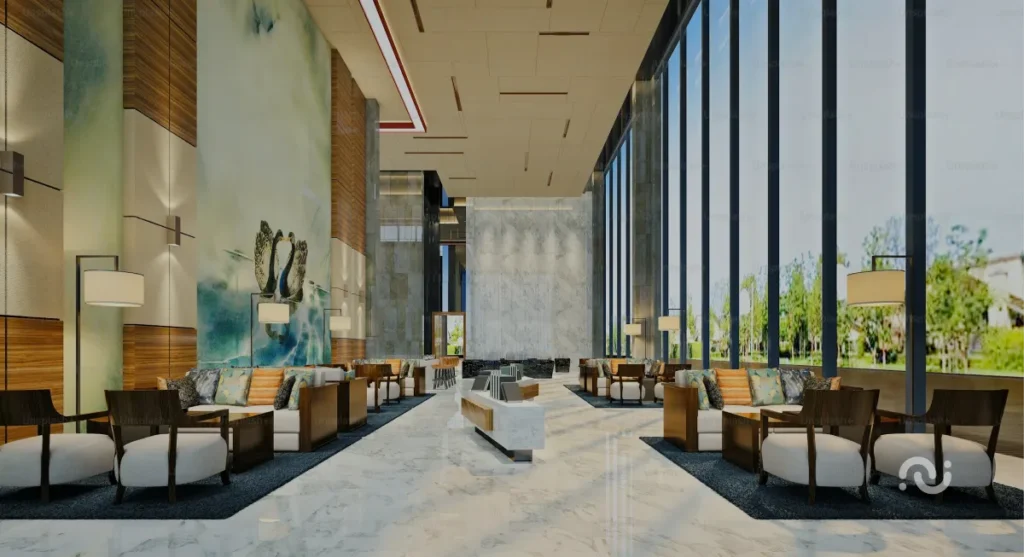
Webchat campaigns are pop-ups, widgets or embedded messages on your hotel website that reach out to visitors directly. They answer questions in real time, present offers and guide potential guests straight into the booking process, instead of waiting for them to open the chat or send an enquiry themselves.
By source, behaviour and context.
Source: The system reads referrer URLs and UTM parameters. This tells it whether a visitor came from a Google ad, a newsletter or Instagram, and it shows content to match.
Behaviour & context: Campaigns respond to specific signals, such as:
A visitor arrives on the Junior Suite page via your wellness weekend ad and has been there for two minutes. Instead of a generic “How can we help?”, a pop-up opens showing the wellness weekend in the Junior Suite, the direct booking benefit and a link to book.
Not every website visitor is looking for a room. Locals are interested in your Sunday brunch, day spa pass or tasting menu. Webchat campaigns target these visitors based on where they come from and how they move around your website, and show them the right offer. That’s revenue without an overnight stay.
Guests book with an OTA when they don’t get a quick answer on your website. Webchat campaigns flip that around: they reach out to visitors proactively instead of waiting for them to ask. And as soon as someone responds, the AI chatbot takes over with:
Our client Paradise Resort shows how it all comes together: five webchat campaigns generated over 17,800 clicks, and between July 2024 and February 2025, 12% of direct bookings came through the chatbot, with a booking value of around €450,000.
The AI-powered Booking Assistant guides the guest through the booking step by step, also asking for their phone number and consent to be contacted. If the guest still drops off (distracted, undecided, comparing prices), automated booking recovery kicks in: if the booking isn’t confirmed within two hours, a personalised WhatsApp campaign starts automatically. That way, an abandoned booking can still become direct revenue before the guest ends up on an OTA.
Because your guests already use WhatsApp every day. They don’t need to download a hotel app, and important information doesn’t end up in the spam folder. The numbers prove it: HiJiffy’s WhatsApp campaigns consistently achieve open rates of over 80%, compared with an average of around 20% for email. AX Hotels saw an 86% open rate on its WhatsApp campaigns, and Paradise Resort 82%. And if a guest doesn’t use WhatsApp, the message goes out automatically by SMS.
In the days before arrival, when guests are planning their trip. On the day of arrival it’s often too late, and the spa may already be fully booked.
That’s why the hotel La Butte ran two WhatsApp campaigns, one a week before arrival and one the day before, each with buttons for the spa, restaurant and activities. The open rate was almost 93%, 18% clicked the spa button and 14% each clicked restaurant and activities. For comparison, the restaurant’s traditional email campaigns achieved an open rate of around 40% and a click rate of 1.6%, meaning WhatsApp generated almost nine times more clicks.
Guests fill in their registration card and pre-check-in form on their smartphone in advance and, where available, receive their digital key straight away on arrival. A manual check-in takes around 10 minutes. Without the paperwork, time at reception drops significantly, and no queues form at peak times. Your front office team then has time for what hospitality is really about: a personal welcome.

“What convinced us most was how well HiJiffy fits into the guest journey. From pre-arrival communication to in-stay messages, it helps us reach guests at exactly the right moment, whether to answer questions or offer relevant extras.”
Joseph Vella
General Manager, AX Hotels
Result: 86% open rate on WhatsApp campaigns and 18% more ancillary sales from upselling campaigns (read the full success story).
With messages triggered automatically by time or by event. Two examples:
Timing is everything. A restaurant offer at 2pm gets booked. The same offer at 9pm misses the mark.
As a rule of thumb, one or two relevant messages beat daily promotions: for example, a welcome on arrival and a short mid-stay satisfaction survey. Daily promotional messages intrude on the very experience the guest has paid for. Relevance beats frequency. The mid-stay survey has another advantage: you hear about problems while you can still act, not from an online review.
Unlike an email newsletter, it starts a conversation, and the AI replies instantly. If the guest asks, for example, whether the spa treatment is also available in the afternoon or whether the upgrade includes breakfast, it answers right there in the chat. With the right integrations, the guest can also book upgrades and extras on the spot. Overall, the AI handles around 90% of guest communication automatically. For complex special requests, complaints or individual issues, it hands the conversation over, with the full history, to the right team: reception, housekeeping or F&B. So a successful campaign doesn’t create extra work for your team. All conversations come together in the HiJiffy Console.
With an automated message shortly before or after check-out that includes a quick satisfaction survey and invites guests to leave a review on Google or TripAdvisor.
With the right integrations, critical feedback goes straight to your team. If the survey goes out before check-out, you can often fix the problem before the guest even leaves.
Guests who book through an OTA are often anonymous to you. That changes during their stay: you capture their contact details through digital check-in or Wi-Fi access. After departure, you contact the guest directly with your loyalty programme or an exclusive offer for their next booking. That brings them into your own channel, and their next booking costs you no commission.
In the post-stay stage, as part of targeted retention and loyalty programme campaigns. The guest still remembers their stay well, and that’s when an early-booking offer for next season works best.
Ideas are one thing. In practice, most hotels are held back by three things: time, marketing know-how and no connection to booking data. HiJiffy’s Campaign Manager solves exactly these three problems with pre-approved templates, a direct connection to your PMS and automated sending.
Through two types of triggers:
This requires a connection to a supported PMS or CRM. After that, recurring messages such as booking confirmations, pre-arrival information or upselling offers run automatically.
Through the PMS integration, every message adapts automatically to the guest’s reservation details, such as their name and dates of stay. Campaigns can also target specific guest segments, for example guests arriving within a certain period.
Recurring campaigns pull their data directly from your PMS or CRM. That way, the Campaign Manager knows who’s arriving when and what status each reservation has. In total, HiJiffy integrates with more than 100 hotel systems, from booking engines and CRMs to reputation management.
Through a central Console. There, the team sees all properties at a glance and creates, manages and monitors campaigns for each hotel without switching between systems. Each property keeps its own settings. When guests reply to a message, the reply is automatically routed to the right hotel.
No. The free Campaigns Library contains more than 250 proven templates for every stage of the guest journey, in three tones: friendly, professional and informative. Choose a template, adapt it to your hotel and schedule it in the Campaign Manager.
HiJiffy hosts its services on AWS in Ireland. Stored data is encrypted with AES-256, and all data traffic over the internet uses TLS v1.2 or higher. You can see which service providers process data on our behalf, and for what purpose, on our Security and Compliance page.
Guest journey campaigns contribute to different goals, depending on your area of responsibility at the hotel:
| Role | What campaigns contribute to | Metrics to track |
|---|---|---|
| General Manager | Revenue per guest, competitiveness against OTAs | TRevPAR, direct booking share |
| Revenue Manager | Ancillary revenue before and during the stay, more direct bookings | RevPOR, upselling revenue |
| Marketing Director | Direct guest relationships, rebookings | Open rate, click rate, rebooking rate |
| Reservations Manager | Fewer abandoned bookings, fewer routine enquiries | Recovered bookings, share of enquiries answered automatically |
| Operations Manager | Lighter workload for reception and front office | Share of digital check-ins, hours saved, CSAT score |
The common denominator: every campaign should move a metric you actually look at in your weekly review. Otherwise, it’s just another message.
1. Find the gaps and choose a starting point: List the stages of the guest journey where you already communicate proactively and where you don’t. For most hotels, the best place to start is a pre-stay campaign combined with digital check-in and upselling.
2. Define your audience and trigger: Decide who receives the message, for example all confirmed reservations arriving next month. Also decide whether the campaign starts at a fixed time or when a reservation changes.
3. Choose your channel: Set WhatsApp as the main channel and SMS as the fallback, so every message gets through.
4. Create your message: Pick a suitable template from our Campaign Library and fill in variables such as the guest’s name or arrival date. Set the languages your guests will receive the message in.
5. Measure and expand: Before launch, decide how you’ll measure success. You’ll see open and click rates directly in the Campaign Manager, and booked upgrades and ancillary revenue in your PMS. After four weeks, compare, adjust and add the next stage.
Two messages per stay aren’t enough, especially for hotels that offer more than a bed: spa, restaurant, excursions or special packages. If you only contact guests at booking and check-out, you pay more OTA commission, sell fewer extras and leave the guest relationship to others.
With campaigns across the entire guest journey, you reach guests via webchat and WhatsApp exactly when it’s relevant to them: triggered automatically, personalised with booking data and consistent across all your properties. Every interaction becomes a chance for more direct bookings, higher ancillary revenue and more regular guests.
Automated, personalised messages that reach guests before, during and after their stay via webchat, WhatsApp or SMS, each at the right moment.
HiJiffy’s WhatsApp campaigns consistently achieve open rates of over 80%, compared with around 20% on average for email.
We recommend 3 to 5 days before arrival. That’s when guests are actively planning their trip and most open to extras.
One or two targeted messages are enough, such as a welcome on arrival and a short satisfaction survey.
No. Campaigns run on pre-configured workflows, and the Campaign Library offers more than 250 templates in three tones.
Webchat campaigns reach your website visitors with relevant offers before they switch to an OTA. If a guest abandons a booking, an automated WhatsApp message can bring them back.
After check-out, you thank them, ask for a review and, at the right moment, send an offer for their next stay, such as a direct booking discount or an invitation to join your loyalty programme.